|
![[News]](../images/64x64/announce.gif)
|
The website for the ReBorCon 2011 that Bas is organising is now available. ReBorCon is a new, international conference for the REBOL family of programming languages, including the current REBOL 2 line, the REBOL 3 in development, and the open source Boron language. The programme includes several topics that are of interest for Syllable.
|
|
|
|
![[Syllable Server with Rox Desktop]](http://nl.syllable.org/2010/SummerSylCon/Syllable-Server-Rox-Desktop.jpg)
During the SylCon Summer conference 2010 we filmed the presentations given. It took a while to process them, but thanks to skûtsje shipper Paul Fortuijn (who took the time of processing all the movies) now they are finally available on YouTube. If you want to view the movies in Ogg video format, use this website: TinyOgg.com.
Topics covered include the Syllable Server release 0.4, the new graphical development version of Syllable Server, advancements in REBOL 3, improvements in our CMS and how we will open up our communication channels. The movies are Dutch spoken. If you want to help making translations and sub-titles of these videos please contact Bas de Lange on the email address mentioned here.
|
|
|
|
We wish everyone a good Syllable year! Last year we promised to create some breakthroughs, and we did. After making the REBOL 3 and Boron programming languages available on both Syllable Desktop and Syllable Server, we started working on their closer integration with the system. We created the first REBOL extension on Syllable, and will soon announce the first binding with a programming library. We made the REBOL 3 collaboration system and the CMS for the Syllable web sites run on Desktop. The CMS became more capable and fifteen times faster, so that it is now much easier for us to maintain the sites. We made a new Syllable Server release, and created a graphical version of it with the ROX desktop, that we are using internally and that has enabled us to move away from non-Syllable Linux distributions (extending our hardware's life span in the process).
Most of these accomplishments are "under the hood". We demonstrated them on the Syllable Conferences and on Software Freedom Day, but they are not easily available yet. So the main goal for this year is to continue with these developments and to make them better available to the public.
|
|
![[Applications]](../images/64x64/applications.gif)
|
![[Syllable Desktop building and publishing its own website]](http://web.syllable.org/images/screenshots/Desktop/0.6.7/SyllableDesktop-building-own-website-200x150.png)
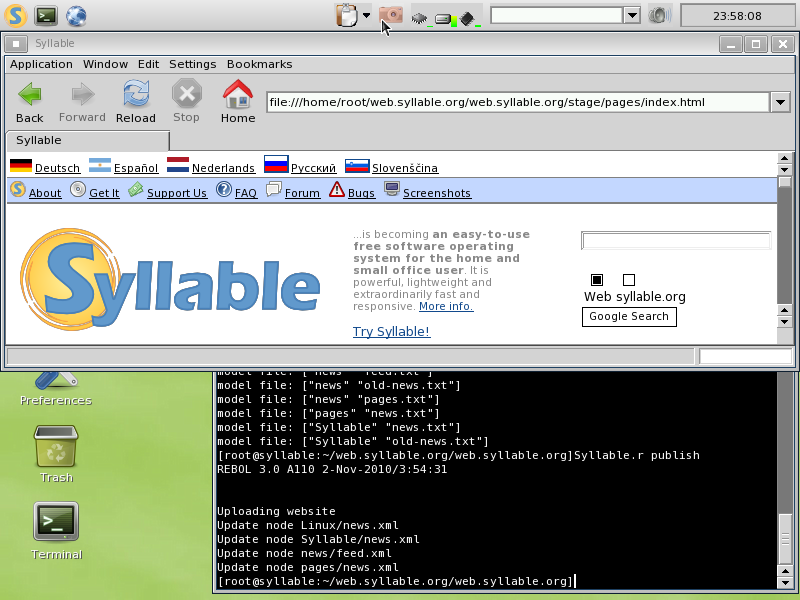
The CMS that builds our websites was used on Syllable Server so far, but now it has been ported to Syllable Desktop. This was done by porting it to REBOL 3. The screenshot shows Desktop building its own website in static batch mode and synchronising it with Amazon S3.
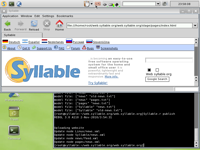 This screenshot shows Webster previewing the built site as local files. Building the websites on Syllable Server is around 35% faster with REBOL 3 than with REBOL 2. A few longstanding problems in our Russian website and documentation were fixed because REBOL 3 now understands Unicode. This screenshot shows Webster previewing the built site as local files. Building the websites on Syllable Server is around 35% faster with REBOL 3 than with REBOL 2. A few longstanding problems in our Russian website and documentation were fixed because REBOL 3 now understands Unicode.
|
|
![[Ports]](../images/48x48/port.gif)
|
![[REBOL 3 RebDev chat on Syllable Desktop 0.6.6]](http://web.syllable.org/images/screenshots/Desktop/0.6.6/REBOL-3-RebDev-chat-on-Syllable-0.6.6-200x150.png)
The latest version of the REBOL 3 open host kit, alpha 110, enables Syllable Desktop for the first time to run the REBOL 3 client/server RebDev collaboration application for chat and development files sharing. It already worked in the Linux version for Syllable Server. The client is not an application that was ported and needs to be installed, but is a small REBOL script that is downloaded in its newest version every time the program is started - much like a web page. It runs unmodified, currently on Syllable Desktop, Syllable Server, Linux, FreeBSD, OpenBSD, Amiga OS (PPC), OS X (Intel & PPC) and Windows.
The source code of the REBOL 3 open host environment is now hosted in a public Git version management repository. To compile REBOL 3 on Syllable Desktop, you need to have the following software packs installed:
- Development files pack for your exact Syllable version
- Developer's Delight
- Network Necessities
To compile REBOL 3 and start the RebDev application, enter the following commands:
    build update
    build log
    build get REBOL-Core--current
    build patch REBOL-Core--current
    build REBOL-Core--current
    build install REBOL-Core--current
    r3
    chat
    new-user
|
|
|
|
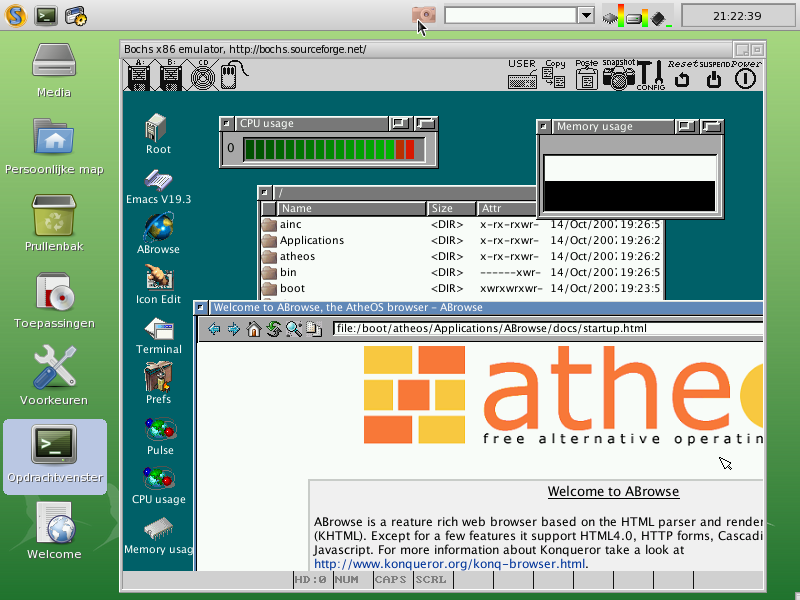
Bas is organising a conference for the REBOL family of programming languages, including the current REBOL 2 line, the REBOL 3 in development, and the open source Boron language. The conference will be held on Saturday February 26 in the Netherlands, in the same venue as the Syllable conferences. Many of the demonstrations will be done on Syllable Server and Syllable Desktop.
We will set up a website for the conference later, but we want to get the word out as soon as possible to gauge interest. If we get international visitors, we have the option to scale up the event to multiple days, including the Friday, to make the journey worth their while. So if you are contemplating coming, or even better if you are interested to give a presentation or demonstration or workshop, please contact Bas de Lange.
Update:
The website is now on-line.
|
|
|
|
![[Boron programming language]](http://web.syllable.org/images/Boron-logo.jpg)
Kaj has overhauled the Boron demonstration he presented at Software Freedom Day for publication on the web. Boron is the programming language that is the successor to the ORCA language that we use in Syllable. If you want to try it, Boron is already available in Syllable Server 0.4 and the development build of Syllable Desktop.
The presentation starts with an introduction to Boron. It then demonstrates how to build a small dynamic website that serves up the presentation itself. So there is a simple website content management system in there and a simple presentation program, in about fourty lines of Boron programming. Both the program and the presentation are available for download.
The demonstration is running on Syllable Server and the Cheyenne web server, just like the original talk at Software Freedom Day. It could also run on Syllable Desktop by using one of the web servers available for Desktop.
|
|
|
|
Ed informs us on our forum that the current September issue of PCLinuxOS Magazine is starting a series of articles about Syllable Desktop. They're written by Darrel Johnston and available on-line. The magazine is free under a Creative Commons license and can be downloaded in PDF format or viewed on the web. The first article introduces Syllable Desktop and shows the installation process with a very nice series of screenshots.
|
|
|
|
![[Software Freedom Day]](http://web.syllable.org/news/SoftwareFreedomDay-emblem-100x100.png)
Friday September 17, Kaj will present two talks at the Software Freedom Day 2010. This event is kindly hosted by the CWI in Amsterdam, the Centre for Mathematics and Computer Science, known best in open source circles as the birthplace of Python.
The first talk presents our graphical development version of Syllable Server running the ROX Desktop, which we recently introduced at the Syllable Summer Conference, and compares it to Syllable Desktop.
The second presentation introduces the Boron programming language, which is the successor to the ORCA language that we use in Syllable. It will demonstrate building a small website with Boron on the Cheyenne web server, also running on Syllable Server.
|
|
![[Syllable]](../images/64x64/Syllable-emblem-63x64.gif)
|
We are pleased to announce that we have released the new Syllable Server 0.4. This release focuses on maturing existing functionality, improving security, ongoing system restructuring, and making the system a suitable base for third-party package managers. Extensive work was done, so the full change log is quite long.
About half the packages in the system were upgraded, including key components such as the Linux kernel, UDev, the LFS init scripts, DirectFB, SDL, BASh, Packager, OpenSSH, REBOL/Core, the Cheyenne web server and CDRTools. Other important packages such as Ruby, Midnight Commander, Links and Transmission were also updated. XZ-Utils was added, providing the same LZMA compression as in 7-Zip, but in a different format that is becoming popular, and is better integrated with POSIX systems. TAr was upgraded and this version has support for XZ-Utils. Compression of the system distribution was changed from 7-Zip to XZ format. The latest development versions of Cheyenne and UniServe are included, which provide a new WebSockets framework for advanced persistent, full-duplex communication with the latest web browsers.
As an example of clearer system structure and improved security, the super user account has been renamed from "root" to "system". Logging in to this account has been disabled: you are now supposed to log in to the account named "administrator" to manage the system. From this account, you can use the sudo command to perform actions with system privileges.
Here is the updated manual, which explains the key abilities of the system step by step. Syllable Server can be downloaded here. Extra software is available here.
|
|
|
|
After many years of trying by several people, Kaj collected their hints and got the server part of OpenSSH to work. The integration into Syllable Desktop is based on earlier integration into Syllable Server of the system configuration needed for the OpenSSH server. Kristian implemented the socketpair function in Syllable 0.6.6 to support OpenSSH, although this currently still needs to be disabled. Michael Pavone and Adam Kirchhoff supplied and tested several other options that need to be disabled to get the server running and stable.
This work is now available in the current development build. To activate the OpenSSH server, edit the file /resources/indexes/init/sshd and uncomment the last line, according to the instructions there. After that, the server will be started on each system start-up. Unique encryption keys that identify your system were already generated at the first start-up of your Syllable installation.
|
|
|
|
![[Kaj de Vos showing Syllable Desktop]](http://nl.syllable.org/2009/WinterSylCon/SylCon-winter-editie-2009-034-200x133.jpg)
Saturday 30th of January 2010 already the second edition of the Syllable Winter Conference will take place in conference centre "Het Brandpunt" in Baarn. Like we did during the first Syllable summer conference with presenting Syllable Server and our WebKit based browser Webster, we will now also make some important announcements. During several presentations and demonstrations we will highlight these. We will also follow up on the content management system, with which you can manage websites on Syllable Server. In this context we will go more indepth into the Try REBOL site, with which you can try out the REBOL programming language in your browser. The recently implemented support for WebSockets on Cheyenne, part of the upcoming HTML5 web standards, with which persistent HTTP connections in an efficient manner become possible, and with that the management of rich interactive websites on Syllable Server, will of course extensively be highlighted. Keep an eye on the Syllable Winter Conference page for the latest updates to the programme.
To give you an impression of the conference, you can see here six Dutch spoken videos on YouTube of the presentations given by Kaj de Vos during the first Syllable Winter Conference in January 2009.
Part 1, deep links into the video: Syllable Desktop, memory management, swap, why do we use Linux as a server kernel?, the using of Syllable in a DVD factory.
Part 2, deep links: WebKit, mounting USB disks, terminal Bash shell, installing extra packages, Battle for Wesnoth, native applications, resource packages, VLC media player, Application Binary Interface.
Part 3, deep links: Unix System Resources, resources directory, symbolic links, no hard links, locality of packages.
Part 4, deep links: search paths, separation of system and independent packages, playing a movie with VLC.
Part 5, deep links: VLC, MediaPlayer, FFMPEG, media framework, hardware overlays, media codecs.
Part 6, deep links: the REBOL song, audio mixing.
If you want to help with making subtitles and translations of these videos please get in contact with Bas de Lange on the here mentioned email address!
|
|
|
|
Over the holidays, the Cheyenne web server that we use in Syllable Server got a WebSocket framework. Cheyenne's author Nenad Rakocevic implemented WebSocket support in just a day on top of the UniServe universal network I/O subsystem that underpins Cheyenne. In a few more days, he designed an original WebSocket framework supporting persistent connections in an efficient manner, extending the regular Cheyenne framework for the typical HTTP stateless request/response communication.
WebSocket is a part of the upcoming HTML5 web standards. It allows a web browser and a web server to have a persistent, two-way full-duplex connection using just one TCP connection. It does this by starting a regular HTTP connection and then effectively renegotiating it into its more flexible underlying TCP connection. This gives it good chances to traverse firewalls, effectively giving us back the full power of the Internet. In this way, it is an evolution and replacement of Comet, which is a collection of hacks to use Ajax to simulate persistent HTTP connections. WebSocket improves over Comet by being standardised, much cleaner and more scalable. It does, however, require explicit support by both the server and the client. Currently, only Chrome 4 has WebSocket support. It is planned for Firefox and Safari. The latter means WebKit and that means we will be able to port it to Webster.
We intend to use this framework in our Syllable web infrastructure. The Cheyenne WebSocket framework is available in its SVN version. A WebSocket echo demo program is available here.
Update:
There is now a demo chat application online. Remember that you need a WebSocket browser for it, such as Chrome 4 or a nightly build of WebKit. You can follow Cheyenne discussions here.
|
|
|
|
![[Math Project 004]](http://ar.syllable.org/news/2010/MathProject-004-200x150.jpg)
Lucas Murad tells us: “I have released Mathematic Project, an application intended for making calculations in Syllable Desktop. This very first public release is a proof of concept and this is the starting point of a whole math utility, with the purpose to avoid the need to port external apps and carry Syllable Desktop to universities and labs where mathematic software is increasingly being used. The app is available at: Math Project 004.”
|
|
|
|
We wish you all a good new year! The new sun is shining strong here, surely the sign of a fertile year to come. Indeed, we will create some breakthroughs this year.
|
|
|
|
The current development build of Syllable Desktop has a greatly improved installation menu. The options for IDE and USB CD players were merged, so that the troubleshooting options can now also be tried with a USB CD player. Specific installation options were added for the Acer Aspire One and ASUS EeePC netbooks. The EeePC requires compensation for its shifting of drive positions, which is now performed by the installer. This was tested for us by Hans Rood on the Summer SylCon, and the Aspire One was tested for us by Ruud Kuin. There are now more safe mode options for troubleshooting, such as an option to fully remove the USB 2 driver, which is buggy on some systems.
Experimental installation options were added for installing from and to USB memory sticks. These don't work yet, because Syllable doesn't start from USB devices other than CD players yet, but this is being worked on. Apart from Syllable's own AFS format, there's an option for starting from USB memory formatted with Linux's Ext2FS file system. Installing to USB is still unreliable on Syllable, so the Ext2FS option allows to experiment with creating a USB installation medium from Linux.
|
|
|
|
At a request from Carl Sassenrath, inventor of REBOL and the Amiga OS, Kaj has created a website that allows you to try the REBOL programming language without installing it. The site showcases the new REBOL version 3 that is close to going into beta release. It also offers to test the classic REBOL 2 and ORCA, the open source implementation of REBOL, and to make comparisons between them.
The website is running on Syllable Server 0.3, in development towards version 0.4. For this application, the security of the server operating system was enhanced to be able to offer the public to run generic REBOL scripts.
The website was made on top of the REBOL stack included in Syllable Server. It runs on the Cheyenne web server. It is made in a Model/View/Controller architecture with the network application platform we have been working on: a combination of the QuarterMaster web framework and the content management system that is also used to build our Syllable websites. This REBOL demo site marks the transition of this application platform to being capable of building advanced interactive websites.
|
|
|
|
At the request of our Spanish web master, Lucas Murad from Argentina, and Leo Ruilova, from Chile, Kristian has opened a section for Spanish speaking Syllable fans on our forum. Do come in and say hello to them!
|
|
|
|
![[Sonic on MEDNAFEN]](http://web.syllable.org/images/screenshots/Desktop/0.6.6/Sonic-on-MEDNAFEN-200x150.jpg)
Rui managed to port MEDNAFEN, an emulator of several classic game computers, including the Atari Lynx, Nintendo Game Boy, NES, Sega Master System and Neo Geo Pocket. Together with the other emulators that already run on Syllable, this brings us many classic games.
|
|
|
|
![[SylCon 2008]](http://web.syllable.org/2008/SummerSylCon/img_8046-200x150.jpg)
Our yearly summer conference will be held from Saturday July 18 to Saturday July 25 in the Netherlands. We will be sailing again on the Frisian vessel the Stêd Sleat while discussing and demoing the Syllable systems. This year we are offering several arrangements, so you can choose how many days you want to attend. There are discounts for longer stays and for kids, so you can make this into a nice vacation for your family. Contact Bas for arrangements.
|
|
|
|
The news sections of the websites have been extended with RSS feeds. If you prefer to follow Syllable news through an RSS reader application, you can now do so. Each selection of the news on the different sites has a corresponding feed. Look for the RSS icons. Please don't let your reader fetch the feeds too often. We don't publish news several times per day, so it's no use to check more often than a few times each day. Each news article now also has its own page, so the feeds can point to them. Good reading!
|
|
|
|
Anthony has implemented keyboard navigation in DiskManager. This means you will be able to install Syllable without using a mouse, in case the installation CD has problems with that. To do this, Anthony had to make fixes to keyboard handling in LibSyllable Views. This will also improve keyboard use in other applications.
|
|
|
|
Anthony has enlightened us by implementing auto-login. In the next Syllable Desktop development build, you will be able to go into the Users & Groups preferences and set a user account to log in automatically, without going through the password dialog.
|
|
|
|
![[]](http://web.syllable.org/images/screenshots/Desktop/0.6.6/Coldfish-on-Syllable-0.6.6-200x150.jpg)
A sigh of relief goes through the audience as we give you the new Syllable Desktop. Thanks go to those who contributed to it and those who helped shake out the last remaining bugs. Many of those were fixed, including several regressions from earlier releases. The window decorators don't destabilise the system anymore. The installation procedure is greatly enhanced with options to fix hardware support problems. The native web browser is replaced with Webster, based on a newer version of the WebKit engine. Many enhancements were made to standards support, leading, among others, to the ability to run QEmu - so now you can run virtual machines. The documentation was improved and several translations were added. Read more in the full release notes. ISO CD images, (VMware) emulator images, an upgrade pack and documentation are available from the download page. Extra software is available here.
|
|
|
|
There's a release candidate for Syllable Desktop 0.6.6 in our development builds now. If you want to influence the final version, this is your last chance to test it.
|
|
|
|
If you think the news articles here are out of line, that's because the web sites got a brand-new news module. Custom made for Syllable, just as the rest of the site. However, the older news items are still in the old style, which is less flexible, so we can't easily update their styling. The new articles are in our custom database and have their content fully decoupled from the styling. They're also easier to write and maintain. It's an important focus of ours to lighten our workload.
|
|
|
|
Kaj has ported XML-Starlet, a suite of XML tools that builds on LibXML2 and LibXSLT. The immediate motivation for the port was the need to process the XML files inside Open Document Format files (as used by OpenOffice and a number of other office applications). In our downloads is an installation package for Syllable Desktop.
|
|
|
|
The current issue of Micro Mart, a weekly computer magazine in the UK, has an article about Syllable and three other alternative operating systems. It was written by Michael Reed.
|
|
| Happy
new year to all! I think we can look forward to it, because there is a
lot of opportunity for it to be better than the last one. :-) | |
| We
have a new Russian translator. Alexander ("azlk" on the forum) has
already done a lot of work on our Russian website, and is also working
on the translation of Syllable
itself. | |
| The Dutch website of Software
Freedom Day
is now running on Syllable Server and the included Cheyenne web server.
This has given the site much more storage space for their multimedia
content, virtual hosting under their own domain names and the freedom
to use server technologies of choice. The site was already made with
the same content management system that Kaj is developing for the
Syllable sites. | |
| Bas picked up the new Dutch
Linux Magazine this morning, that has hit the shops now. This
November issue, number 5 of this year, has a four-page article on
Syllable, including an interview Kristian did with them. | |
| Bas has
announced that he will organise the first winter edition of
the Syllable Conference. We set up its
own page for it, where Bas will keep you posted as the event
evolves. | |
| Dmitry ("Rohan" on the forum) has requested an
official Russian website, so we set it up. Dmitry will be translating
it over time. | |
| Kaj
will be presenting the brand new Syllable Server 0.3 at the Software
Freedom Day event coming Saturday, September 20, in the city
of Utrecht
in the Netherlands. He will also be present at the Holland Open
Software Conference in Amsterdam the two days before.
Although there
won't be a Syllable presentation there, if you'd like to speak with Kaj
you can catch him while walking around, or enquire with Bas at the
Software Freedom Day booth at HOSC. | |
| Thanks to the fact that Syllable Server is a
Linux, and after having gone through their waiting
list, Syllable is now listed
on DistroWatch,
the major monitoring site of Linux distributions and a few BSD and
Solaris systems. | |
| The
third release of Syllable
Server has been published. This is an important release, because it is
the first one that focused on making the system actually usable as a
server. A number of popular servers were added and configured, and also
several innovative REBOL software stacks. Out of the imaginary box,
Syllable Server is now ready for such things as accepting remote SSH
log-ins over the network, running a web server on the Cheyenne REBOL
server, running an FTP server and several more. Special attention has
been paid to programmability, with support for developing
Model-View-Controller web applications in QuarterMaster
and networking
applications with the REBOL/Services
Service Oriented Architecture. The
Genode Nitpicker
windowing system is also included. Read the rest in the full changelog. An extensive
manual was also written, which is easy to follow. As usual,
both a BitTorrent
download
(preferred) and a regular
download are available (80 MB 7-Zip archive). Please use the
torrent if you
can.
| |
|
| Apart
from organising Syllable events, Bas is very active in circles of open
source, open standards and open content in general. A truly open guy.
:-) He also organises Software Freedom Day in the Netherlands. His
free event will take place next weekend on September the 13th.
It's well worth attending, with around twenty organisations setting up
booths and holding talks. In addition, Bas will be demonstrating
Syllable and the upcoming new Syllable Server release. | |
| Bas will be representing Syllable at the T-DOSE conference in
the Netherlands,
the free Technical Dutch Open Source Event, "The place where experts
meet". In the weekend of October 25 and 26, in the city of Eindhoven,
at the Fontys University of Applied Science, there will be more than
twenty speakers and many open source projects will shed light on their
workings. Bas will present Syllable in a talk and man a booth. | |
| Localised web sites are springing out of the
earth. Michael Utz and Matic Gradiser have offered to be the editors of
German and Slovenian versions of our web site, respectively, so we
created them. As with the other
translated sites, Michael and Matic will complete and maintain the
translations
over time. They would also like to
try their hand at creating and maintaining the German and Slovenian
translations of Syllable itself. | |
| We moved our forum to a new hosting location. If you bookmarked it, please update the
link. All data is migrated, so you can simply log in as before. | |
| Kristian
tracked down and fixed the bug that prevented Syllable from booting off
a USB device. We published a new development build that will boot from
a USB CD player. This means Syllable can now be installed on machines
that don't have an IDE CD player, such as the Asus Eee PC and other
small laptops. Also, with some extra settings in the boot
loader, it
should now be possible to install Syllable to a USB device, such as a
memory stick. On SylCon, we found out that the extra SD memory slot in
the Eee PC is connected via USB internally. It should now be possible
to install Syllable to an extra memory card, so you don't have to touch
the default operating system on the main drive.
The new
development build also has the new Webster browser included.
Update:
further bugs in our USB support turn out to cause lock-ups when trying
to install to a USB medium such as a memory stick. This problem will
need to be fixed before we can do so. | |
|
| ![[ImageViewer]](http://web.syllable.org/images/screenshots/Desktop/0.6.5/ImageViewer-200x150.jpg) Jonas
Jarvoll released his new Image Viewer application. It's more capable
than the AView picture viewer that's included with Syllable. Image
Viewer is now listed in our applications downloads. Jonas
Jarvoll released his new Image Viewer application. It's more capable
than the AView picture viewer that's included with Syllable. Image
Viewer is now listed in our applications downloads. | |
| ![[Webster]](http://web.syllable.org/images/screenshots/Desktop/0.6.6/Webster-tabs-windows-200x150.png) More creative
destruction. Another long-time milestone has been reached.
It has always been our plan to factor out the web rendering engine of
ABrowse into a library with a native Syllable View widget on top, so it
can be embedded into more applications than just a web browser.
Kristian did just that: building on Arno's WebCore port, he updated
that and then stepped up the modularisation by creating the WebView
class. He rewrote the browser on top of that and named it Webster. The
first alpha version is available in our applications downloads. The
latest Syllable 0.6.6 development build is required to run it, as
several bugs in the system were fixed for the new browser. The source
code is available on our development site. More creative
destruction. Another long-time milestone has been reached.
It has always been our plan to factor out the web rendering engine of
ABrowse into a library with a native Syllable View widget on top, so it
can be embedded into more applications than just a web browser.
Kristian did just that: building on Arno's WebCore port, he updated
that and then stepped up the modularisation by creating the WebView
class. He rewrote the browser on top of that and named it Webster. The
first alpha version is available in our applications downloads. The
latest Syllable 0.6.6 development build is required to run it, as
several bugs in the system were fixed for the new browser. The source
code is available on our development site. | |
| We slept through a storm on the ship. We docked
alongside a clipper a bit too hastily; another clipper, the
Hollandia, crashed into us. Nothing new, shippers from Holland have
always sucked. We saw a Black-headed Gull die; we saw a Great Crested
Grebe feed a fish to her young. Nothing else is important, is it? Oh,
there's another cycle of destruction and creation. We demonstrated a
new development build of Syllable
Server that we created just before the conference.
While we were sailing in Friesland, Kristian produced a new development
build of Syllable
Desktop in England. Both are now published here. | |
|
| Unfortunately,
we had to replace our Spanish web site. We extended our content
management system to create a fully integrated new one, so it is now an
official branch of our main web site. Lucas Murad created the old site
and will be editing the new one.
We took the opportunity to
also
overhaul our Dutch site and pull it into the content management system.
Bas de Lange is the editor. The sites currently still show the original
English content. The editors will be translating it over time. | |
| As
last time, we have been invited again to the BeGeistert BeOS meeting,
the 019 edition. It will be held from 10 to 12 October in the same
venue in Düsseldorf
in
Germany. Bas will be there to represent Syllable again. | |
| The
Syllable Conference 2008 will start in a week. We will be holding
presentations and workshops around the upcoming Syllable Desktop 0.6.6
and Syllable Server 0.3. There will be a workshop showing how to set up
a complete network with Server and Desktop machines and how, if you
know one, you know the other. We will also try to install Syllable on
an Asus EeePC. | |
| We released a development build of Syllable
Server.
This version has a number of updated components, including the kernel,
and several fixes. Most importantly, a lot of server functionality was
added. Included is a REBOL software stack with a web server and a web
programming framework. Support and start scripts are integrated for a
number of standard
servers, such as CUPS, OpenSSH, BIND, Apache, RSync, SaMBa and VSFTP.
However, the configurations of these new modules are not complete yet. | |
|
| ![[VLC]](http://web.syllable.org/images/screenshots/Desktop/0.6.5/VLC-on-Syllable-0.6.5-200x150.jpg) Ruwen Boehm ported
the VLC and MPlayer multimedia
players to Syllable Desktop. The behaviour of both is still a bit
rough, but watching DVDs on Syllable is possible now. Some of the
needed parts were ported by Rui Caridade, Andrew Kennan and Kaj de Vos.
Newly ported components include FAAD2, FLAC, FontConfig, LibA52,
LibCDDB, LibDVDNav, LibDVDRead, LibID3Tag, LibMAD and LibMPEG2. These
packages don't have to be installed separately, as the libraries are
included in VLC and MPlayer. Packages for both are in our resources
downloads. They need to be started from the command line,
until someone writes native Syllable graphical control interfaces for
them. Ruwen Boehm ported
the VLC and MPlayer multimedia
players to Syllable Desktop. The behaviour of both is still a bit
rough, but watching DVDs on Syllable is possible now. Some of the
needed parts were ported by Rui Caridade, Andrew Kennan and Kaj de Vos.
Newly ported components include FAAD2, FLAC, FontConfig, LibA52,
LibCDDB, LibDVDNav, LibDVDRead, LibID3Tag, LibMAD and LibMPEG2. These
packages don't have to be installed separately, as the libraries are
included in VLC and MPlayer. Packages for both are in our resources
downloads. They need to be started from the command line,
until someone writes native Syllable graphical control interfaces for
them. | |
| ![[EeePC]](http://web.syllable.org/images/screenshots/Desktop/0.6.5/SyllableDesktop-0.6.5-on-EeePC-200x150.jpg) Michael Saunders got
Syllable
Desktop to run on his new Asus Eee PC - a machine for which it is
uniquely suited.
There is some work to do to support all hardware, but most
functionality already works. Michael reports that video, audio,
touchpad, USB and battery monitor all work. Widescreen video and
network don't and there may be reliability problems with USB storage
devices. As installing Syllable from a USB device doesn't work yet,
Michael used an inventive method for installation. It can be done by
imaging your Eee drive with the dd utility (from Linux), installing
Syllable on it through QEmu and then dd'ing the image back to the real
drive. Note that the drive number needs to be adjusted in the GrUB boot
file. We are looking into distributing Syllable especially for the Eee
PC in this form. Michael Saunders got
Syllable
Desktop to run on his new Asus Eee PC - a machine for which it is
uniquely suited.
There is some work to do to support all hardware, but most
functionality already works. Michael reports that video, audio,
touchpad, USB and battery monitor all work. Widescreen video and
network don't and there may be reliability problems with USB storage
devices. As installing Syllable from a USB device doesn't work yet,
Michael used an inventive method for installation. It can be done by
imaging your Eee drive with the dd utility (from Linux), installing
Syllable on it through QEmu and then dd'ing the image back to the real
drive. Note that the drive number needs to be adjusted in the GrUB boot
file. We are looking into distributing Syllable especially for the Eee
PC in this form. | |
|
| Bas
has announced the Syllable Conference 2008. Like last year's successful
conference, it will be held in the Netherlands on the Frisian sailing
vessel the Stêd Sleat (the former racing ship of the city of
Sloten).
There is limited space available. Make sure you don't miss the
atmosphere, the adventure, the comradery, the Syllable presentations,
the talks, the plans and the announcements in this break-through year
for Syllable. Read the full announcement at
the forum and enlist with Bas de Lange. | |
| Rohan reports that an
otherwise unknown contributor going under the name Bean has rewritten
the AFS
filesystem driver for GrUB 2.
The original driver was for GrUB 1 and was derived from the full AFS
driver. This meant that the copyright could not be reassigned to the
FSF, so the GrUB project didn't want to integrate the code. The new
driver is much smaller and looks like it will be integrated into GrUB,
so we will have a new boot loader and maintenance will become much
easier. Before that happens, though, we may have to do more porting
work on GrUB 2 to integrate it in our build process and installer.
Here
is a separate
test CD that is capable of booting an existing
Syllable installation on disk. | |
| ![[Squeak with Seaside]](http://web.syllable.org/images/screenshots/Desktop/0.6.5/Squeak-with-Seaside-200x150.png) Kelly Wilson has
ported Squeak
to Syllable.
Squeak is a multimedia
environment based on the Smalltalk
programming language. There are no
video and sound drivers yet that interface between Squeak and Syllable,
so the Squeak graphical environment is not available yet. However,
headless Squeak programs that don't need a graphical user interface
run, and the screenshot shows a web site in ABrowse, produced by the
Seaside web application framework. Kelly Wilson has
ported Squeak
to Syllable.
Squeak is a multimedia
environment based on the Smalltalk
programming language. There are no
video and sound drivers yet that interface between Squeak and Syllable,
so the Squeak graphical environment is not available yet. However,
headless Squeak programs that don't need a graphical user interface
run, and the screenshot shows a web site in ABrowse, produced by the
Seaside web application framework. | |
| Here
is a photo of the Syllable stand at FOSDEM last week, by
Jesús
Corrius. | |
| Michael Pavone has created a new programming
language: Rhope.
It's a very interesting language that is based on dataflow and also
uses transactional concepts to make parallel programming easy. Rhope is
an interpreter that is available for Syllable, OS X and Windows. Mike
mentions that it was for a large part developed on Syllable and that
its web site runs on Syllable Desktop, on a web server and web
framework programmed in Rhope itself. Rhope currently has preliminary
support for programming graphical user interfaces on Syllable and
Windows. | |
| There's a new Syllable website in Dutch. It is
maintained by Bas de Lange and hosted by the region
Utrecht/Amersfoort of the Hobby Computer Club. The link is
available here in the community panel on the left. | |
| ![[Syllable on Syllable]](http://web.syllable.org/images/screenshots/Desktop/0.6.6/Syllable-on-Syllable-200x160.jpg) QEmu
has been eluding its port to Syllable Desktop, but the Syllable team
has gotten this emulator to work now. The port is based on earlier work
on QEmu itself and on a number of improvements that are being made to
Syllable Desktop. The coming Syllable development builds will have
improved support for POSIX threads, timers and async I/O.
The newest QEmu version 0.9.1 runs now. There is already a
binary package of QEmu 0.9.1 for Syllable Server in our downloads
section. QEmu
has been eluding its port to Syllable Desktop, but the Syllable team
has gotten this emulator to work now. The port is based on earlier work
on QEmu itself and on a number of improvements that are being made to
Syllable Desktop. The coming Syllable development builds will have
improved support for POSIX threads, timers and async I/O.
The newest QEmu version 0.9.1 runs now. There is already a
binary package of QEmu 0.9.1 for Syllable Server in our downloads
section.![[Ubuntu on Syllable]](http://web.syllable.org/images/screenshots/Desktop/0.6.6/Ubuntu-running-on-Desktop-0.6.6-200x160.png)
Other
recent ports to Syllable Desktop include
LibPurple and Finch, the text mode client of Pidgin (the former GAIM
instant messaging application) and the latest version of SaMBa, 3.0.28. | |
| We published a new Premium CD for Syllable
Desktop 0.6.5. As always, it's available from the Syllable shop.
The complete program source code didn't fit on it any more, so we
created a separate CD for that. It holds the source code for Syllable
Desktop, Syllable Server and extra packages. Both CDs are also
available as a download from now on, so you can choose to
receive them sooner and save the shipping costs by burning
your own CD. | |
|
| BeGeistert 018 is in progress, where we were
graciously invited. You can see it live on this
webcam. Bas is representing Syllable there and just gave a
spontaneous presentation. | |
| After
an extensive development period, we released Syllable Desktop 0.6.5
with goodies all over. Of course there are bug fixes, most notably in
USB and the network stack, leading to large reliability and performance
improvements. LibUSB and SANE were ported, so there is now USB access
from user space and support for scanners. There are new network and
video drivers, including a unique S3 DeltaChrome driver that Arno wrote
from scratch. Two new window decorators debut from John Aspras. CD
burning ability is now integrated in the form of SimpleBurn and
CDRTools. A new network preferences applet from Andrew Kennan was
integrated, and also Arno's port of OpenBeFS. Many ports were upgraded
and the system layout has been heavily reorganised. Files needed for
compiling software have been split off in a separate package.
This
is also the release that harmonises a number of things between Syllable
Desktop and Syllable Server.
The full change
log is
here. Installation CDs, the upgrade, and images for
emulators are
here. Additional software can be
found here.
| |
|
| The
link to our Official Releases in the navigation panel on the left here
has been replaced by a new download page of our own. After going
through several download web sites in the past years, this one is meant
to stay. It is fully integrated into the new content management system
for the sites. We will extend it over time to add categories,
main
sections for Syllable Desktop and Syllable Server, and eventually,
software contributed by individual developers.
The
current page
offers some new packages that were created or ported recently. They are
mainly libraries, of interest to software developers. | |
| The
second release of Syllable
Server is now available. A number of fixes were made, most notably to
terminal initialisation and printing. GhostScript is included now. Some
of the Syllable-specific initialisation scripts are executed now.
Many
packages were updated, including GLibC, CoreUtils, BASh, ORCA and the
printing packages.
Several
new packages were added. IPTables is included, so Syllable Server can
be used to build a firewall. The wireless tools are included for
configuring wireless networks. The ALSA userspace library and tools
were added to provide full access to the audio system, instead of
relying on OSS emulation.
All separate binary
software packages
for Server 0.1 are still valid on Server 0.2. On Syllable, binary
compatibility is maintained as much as possible.
[Installation
and usage instructions, change
log, torrent
(preferred), installation
package (75 MB 7-Zip archive).] Please use the torrent if you
can.
| |
|
| Bas
will be manning a booth to present Syllable at the Show that
you
Share! conference in the city of Utrecht in the Netherlands on Friday,
December 14 [flyer
(PDF)]. The conference is about networks, communities and learning,
with a focus on educational purposes. We will highlight the opportunity
that Syllable offers to learn about system technology without the huge
overhead that other systems bring with them (for example in code size)
and the low barrier to entry for contributing to Syllable. | |
| Bas
is going to represent Syllable again on the FOSDEM 2008 conference in
Brussels in the weekend of February 23 and 24. We will have a table to
present Syllable. Please come, as it's a great gathering of free
software enthusiasts, and if you want to help, please contact us. | |
| Lukas Veselovsky has opened a web site for
Syllable in Slovak. Good luck, Lukas! | |
| Ruud has published the second issue in the new
series of our Syllable Development Newsletter. It contains thirteen
pages of articles, interviews and the second instalment of Kristian's
programming tutorial. The newsletter is accompanied again by a software
pack, rounding up seven packages that were released since the first
edition. | |
| Another
development build of Syllable Desktop is ready. From now on, the
development builds will be available from their own page on the new
development site. A link is on the panel on the left. The caveats are
the same as for the previous build. | |
| This web site has been split into subsites
oriented towards different audiences. A new site was created for
software developers. It can be reached through the new
"Subprojects/Navigation" panel on the left and contains all the content
that is specific to software development on Syllable. The API
references and driver tutorials are now on-line again. | |
| A Danish tribe is emerging from the Syllable
hordes of the north. Flemming is leading his people and his turtle to a
new Danish
site he has split off from Syllable Norden. | |
| To enable you to try Syllable Server without
installation, two preconfigured virtual
machine images are now available. One is for VMware [torrent
(preferred), image
(82 MB)]. It can also be used with QEmu and VirtualBox. The
other is
for other emulators such as Bochs, or also QEmu [torrent
(preferred), image
(81 MB)]. Please note that the latter unpacks to a file of one
gigabyte. The start menu of the images provides configurations for
several emulators. More detailed instructions are
here. Please use the torrents if you can. | |
| It's the melancholical season in Scandinavia,
so in an attack of nostalgia, Flemming installed the last version of
AtheOS in an emulator image - exactly six years after its release. For
a walk down memory lane, or to peer at Syllable's roots, have a look at
this
screenshot of AtheOS running on Syllable. To try it
yourself, we provide a VMware image that can also be used with QEmu and
VirtualBox [torrent, image
(11 MB)],
and a raw image that can be used with Bochs and QEmu [torrent, image
(11 MB)]. Please use the torrents
if you can.
For unpacking the files, you need 7-Zip [portable version,
Windows version]. | |
| We
are resuming the regular development builds of Syllable Desktop. The
new build contains important stability fixes for USB, and
enhancements to make the porting of software easier. There are fixes
for making it easier to find the SDL extension libraries during the
compilation of software. Configuration of packages that need PkgConfig
during compilation is now supported. If you are building this software
in a staging area, you also need to update Builder, which now also has
support for PkgConfig.
The FFMPEG codec and cURL are
missing
from this build due to temporary build failures. If you need them, you
can copy them in from the previous development build or from Syllable
0.6.4.
[Torrent,
ISO,
MD5
checksums.] Please use the torrent if you can. | |
| The first development release of Syllable
Server is available! It provides a text mode Linux environment, but
also contains a preliminary graphical environment built on the
framebuffer device, with DirectFB and SDL on top. The planned graphical
environment from Syllable Desktop is not included yet. The installation
procedure is short, but is still manual - and resembles the
installation procedure for the old AtheOS.
Included are tools such as a graphical web browser, a file manager and
an editor. One thing Syllable Server is designed for is to function as
a light-weight virtualisation platform for running other operating
systems (or multiple instances of itself). The QEmu
virtualisor/emulator is included, and the KQEmu Accelerator kernel
module is integrated into the system. [Screenshot
of Syllable Server running on Syllable Desktop, installation
and usage instructions, torrent
(80 MB), installation
package (80 MB).] Please use the torrent if you can.
Dutch
IT journalist Brenno de Winter already published
an article about the launch of Syllable Server and a podcast interview
with Kaj de Vos.
|
 Digg
this Digg
this |
| After
a long time, we have updated the Premium CD that is available from our
Lulu shop. At the time, after we released Syllable 0.6.0a, we cleaned
up old library versions from the system, to bring down the size of the
distribution. This meant dropping support for old binary programs, so
after that, our software collection was rather limited and not
sufficient to build a premium CD that would contain significantly more
than the basic installation CD. Since then, we have done a lot of work
on our package collection, and now we have finally made time to create
a Premium CD for Syllable 0.6.4. It is filled to the brim and contains
all our official packages and accompanying source code. | |
| Our new and already prolific contributor Kelly
Wilson has ported MLGame,
a game programming framework for the OCaml
language that makes use of Syllable's SDL
subsystem. Kelly has also updated our OCaml port to the latest version,
3.10, which now has support for PThreads on Syllable for the first time. | |
| Resuming our regular news coverage, we are
pleased to announce that our contributor Rohan has opened a new
Syllable web site in
Russian. It will be available from here in our redesigned
links section, on the left. | |
| Mail addresses of the Syllable members at
syllable.org are now operational again. | |
| After
having moved our domain name registrations to a new provider, we are
now reconfiguring them for the new hosting situation. An effect of this
will be that our site names www.syllable.org and syllable.org will not
resolve for the coming one or two days. Don't worry, we'll be back. |
|
|
| If
you've had a blast from the past lately, it may be because we're
piecing this website back together again from anything we can find.
Although our provider is one stiff
parrot,
we are making this into an opportunity to replace our troubled systems
of the past with the improvements we had long been planning. We would
like to thank those who have offered us hosting help. However, our
plans have already been set in motion. The website you are reading now
is replicated over the world on a distributed system. It should be well
prepared for the extra visitors we are expecting when we release
Syllable Server. The content management system is our own, which we are
writing in REBOL as we speak.
"Elluk naadeel hep sun foordeel."
Johan
Cruyff, after a disastrous soccer match
|
|
|
|
 About
About
 Get It
 Support Us
 FAQ
FAQ
 Forum
Forum
 Bugs
Bugs
 Screenshots
![[Syllable Logo]](../images/Syllable-logo.png)

![[Syllable Desktop showing multiple open filer windows]](http://nl.syllable.org/2010/SummerSylCon/Syllable-Desktop-filers.jpg)
![[Syllable Desktop building and publishing its own website]](http://web.syllable.org/images/screenshots/Desktop/0.6.7/SyllableDesktop-building-own-website.png)
![[REBOL 3 RebDev chat on Syllable Desktop 0.6.6]](http://web.syllable.org/images/screenshots/Desktop/0.6.6/REBOL-3-RebDev-chat-on-Syllable-0.6.6.png)
![[Kaj de Vos showing PenguPop on graphical development version of Syllable Server during WinterSylCon 2010]](http://web.syllable.org/2010/WinterSylCon/Kaj-de-Vos-showing-PenguPop-200x150.jpg)
![[Math Project 004]](http://ar.syllable.org/news/2010/MathProject-004.jpg)
![[Sonic on MEDNAFEN]](http://web.syllable.org/images/screenshots/Desktop/0.6.6/Sonic-on-MEDNAFEN.png)
![[]](http://web.syllable.org/images/screenshots/Desktop/0.6.6/Coldfish-on-Syllable-0.6.6.png)
![[ImageViewer]](http://web.syllable.org/images/screenshots/Desktop/0.6.5/ImageViewer.jpg)
![[Webster]](http://web.syllable.org/images/screenshots/Desktop/0.6.6/Webster-tabs-windows.png)
![[VLC]](http://web.syllable.org/images/screenshots/Desktop/0.6.5/VLC-on-Syllable-0.6.5.png)
![[EeePC]](http://web.syllable.org/images/screenshots/Desktop/0.6.5/SyllableDesktop-0.6.5-on-EeePC.jpg)
![[Squeak with Seaside]](http://web.syllable.org/images/screenshots/Desktop/0.6.5/Squeak-with-Seaside.png)
![[Syllable on Syllable]](http://web.syllable.org/images/screenshots/Desktop/0.6.6/Syllable-on-Syllable.png)
![[Ubuntu on Syllable]](http://web.syllable.org/images/screenshots/Desktop/0.6.6/Ubuntu-running-on-Desktop-0.6.6.png)